

A security team for an automotive software project recently received an urgent alert.
The issue involved a specific function within a widely used open source library. The report warned that an external attacker could exploit this function to read internal system information or trigger abnormal operations.
At first, the solution seemed simple:
“We just need to find the projects using that specific open source library.”
However, reality proved much more difficult. The open-source library in question did not appear in any package lists. It wasn’t listed in the SBOM(Software Bill of Materials), nor was it documented in any development records.
Was the system safe?
Unfortunately, No.
The problem was that a developer had previously copied a few specific lines of code (a snippet) from that open-source project rather than importing the entire library. Over time, that code was slightly modified and treated as if it were proprietary, in-house code.
To the naked eye, it looked like original code. Beneath the surface, however, the “DNA” of the vulnerable open-source function remained.
The security team had to manually trace the code: which project it belonged to, which products it was integrated into, which versions were affected, and which supplier provided it. While the vulnerability was public and attackers were already analyzing it, the security team couldn’t answer the most critical question:
“Where exactly is this dangerous code located in our product?”
[Real-World Challenges at the Michigan Automotive Cybersecurity Event]
This scenario mirrors the concerns shared at the 16th Michigan Automotive Cybersecurity Event held in Ann Arbor in March 2026. Industry leaders from global automotive, manufacturing, and tech companies moved beyond simple vulnerability detection, asking more pointed questions:
- “What exactly is contained within the software entering through our supply chain?”
- “When an open-source vulnerability is found, which specific vehicles and parts are affected?”
- “Can we detect vulnerable functions copied into the code, even if they aren’t in the package list?”
- “How do we create and manage SBOMs to meet US and European security regulations?”
Two key areas of focus emerged from the event:
- Code Fingerprinting and Snippet-Level Detection: “Snippets” are small fragments of code. When only a few lines of a function are copied, standard analysis tools often miss them. Yet, the vulnerability remains.
- Post-Generation SBOM Management: Attendees emphasized that generating an SBOM is only the first step. The real challenge lies in the continuous management exchanging SBOMs between OEMs and multiple tiers of suppliers and linking them to emerging vulnerabilities.
The message was clear: Automotive security is shifting from merely “finding bugs” to making the entire software supply chain visible and manageable.
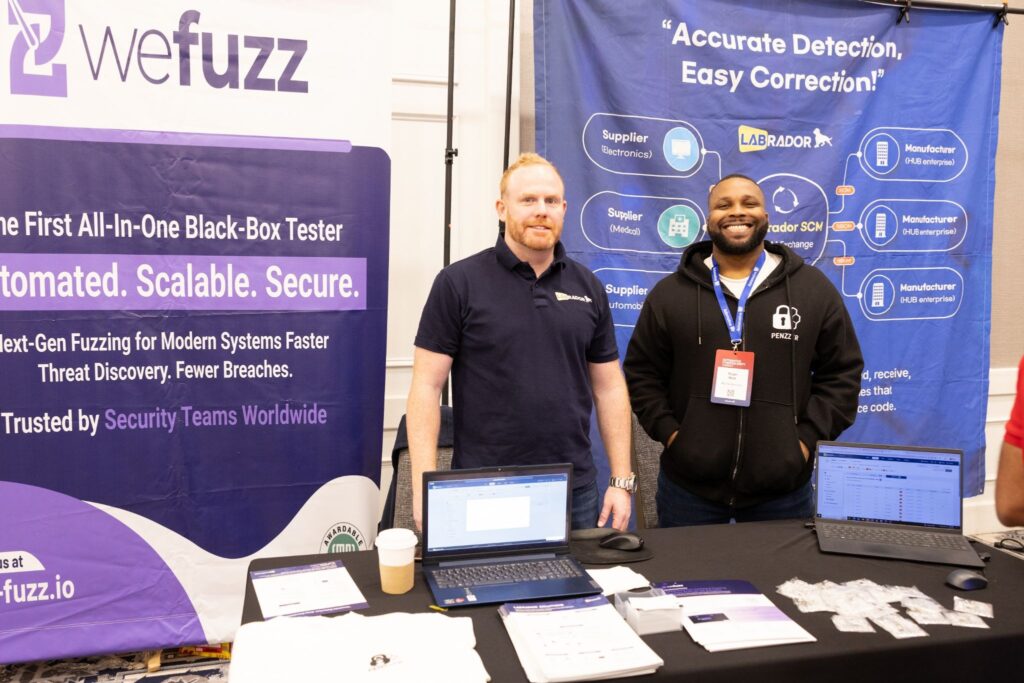
Labrador Labs participated in the 16th Michigan Automotive Cybersecurity Event held in Ann Arbor, Michigan, where they engaged with and listened to the voices of U.S. customers.
Security Starts with “Knowing What’s Inside”
In the past, cars were defined by hardware-engines, wheels, and chassis. Today’s Software-Defined Vehicles (SDV) are different. Everything from infotainment, cameras, and sensors to battery management and autonomous driving is powered by software.
In the SDV era, manufacturers and suppliers must be able to answer:
- What software is inside this vehicle?
- Where did that software come from?
- Are there dangerous code snippets hidden within “original” code?
- Can we prove our security posture to regulators and customers?
SBOM(Software Bill of Materials) is the essential starting point. A single vehicle contains code from OEMs, Tier-1 and Tier-2 suppliers, semiconductor firms, and open source communities. Without a clear “inventory” (SBOM), responding to a new vulnerability becomes a race against time that the industry cannot afford to lose.
In the era of SDV (Software Defined Vehicles), a software flaw is no longer just a “bug.”
It is a direct reason for a recall. The moment a CVE(Common Vulnerabilities and Exposures) is disclosed within an open-source library embedded across tens of thousands of components, a company must immediately evaluate three critical factors:
- Does the vulnerable code actually exist in our vehicles?
- Does this code affect core functions such as steering or braking?
- Is a patch required?
Labrador assists in making rapid recall decisions by detecting vulnerable function code snippets, identifying exactly whether fatal CVE code is in use and where it is located.
Consequently, in the SDV era, an SBOM(Software Bill of Materials) is not just a document. it is the fundamental ledger for managing the automotive software supply chain. Now that cars have become “software on wheels,” security competitiveness is not measured by the volume of code, but by how well you understand that code and how quickly you can respond to threats.
[Labrador Labs: Total Visibility for the Supply Chain]
At Labrador Labs, we believe the core of automotive security isn’t just finding more vulnerabilities.
it’s about making the supply chain transparent.
- Labrador SCA: Goes beyond package analysis. Using code fingerprinting, it detects risks at the snippet level, identifying dangerous code fragments even when they’ve been copied and pasted.
- SBOM SCM: Moves beyond static files. It provides a platform to exchange, track, and manage SBOMs across the complex web of OEMs and suppliers, keeping them continuously linked to the latest vulnerability data.
As cars become “software on wheels,” security competitiveness is no longer measured by the volume of code, but by the speed and accuracy of the response. Labrador Labs provides the framework needed for the SDV era from SCA based analysis to comprehensive supply chain management.
📌 Contact to Team Labrador Labs today!
Phone: US Office +1 650-278-9253 (Mon–Fri, 9 AM–6 PM)
Email: contact@labradorlabs.ai (1:1 demo requests and pricing inquiries)
[Reference]
Automotive IQ, “16th Automotive Cybersecurity 2026,” Automotive IQ, 2026.03.
URL: https://www.automotive-iq.com/events-automotive-cybersecurity