

AI is finding vulnerabilities faster than ever. Your operating servers need a BOM too!
A Software Bill of Materials (SBOM) is the foundation of software supply chain security. It lists the software, libraries, and components used to build a product, along with how they relate to one another.
But once that software is installed on a server, new questions come up. What is actually installed on the server right now? Which of those components are running? When a vulnerability is disclosed, which servers should you check first?
This is where the Operations Bill of Materials (OBOM) comes in.
What Is an OBOM?
An OBOM records the software makeup and status of your operating servers. It shows what is installed, what is running, and which risks to look at first.
An OBOM keeps software on the list even when it isn’t running, because it could be used again at any time. Alongside the inventory, it shows operational details such as execution status and open ports, so you can decide what to fix first. OBOM is also one of the BOM types covered by CycloneDX, the international SBOM standard.
How Is OBOM Different from SBOM?
Think of an SBOM as the ingredient list for a dish. If one ingredient turns out to be a problem, you can trace every product that uses it. But an SBOM mostly reflects the state of things at build and release time. It can’t tell you on its own whether a component is running on a server after installation, or whether it can be reached from outside.
An OBOM works more like a status dashboard for your operating environment. It brings together installed software, execution status, and open ports, giving you a clear picture of each server as it is today.
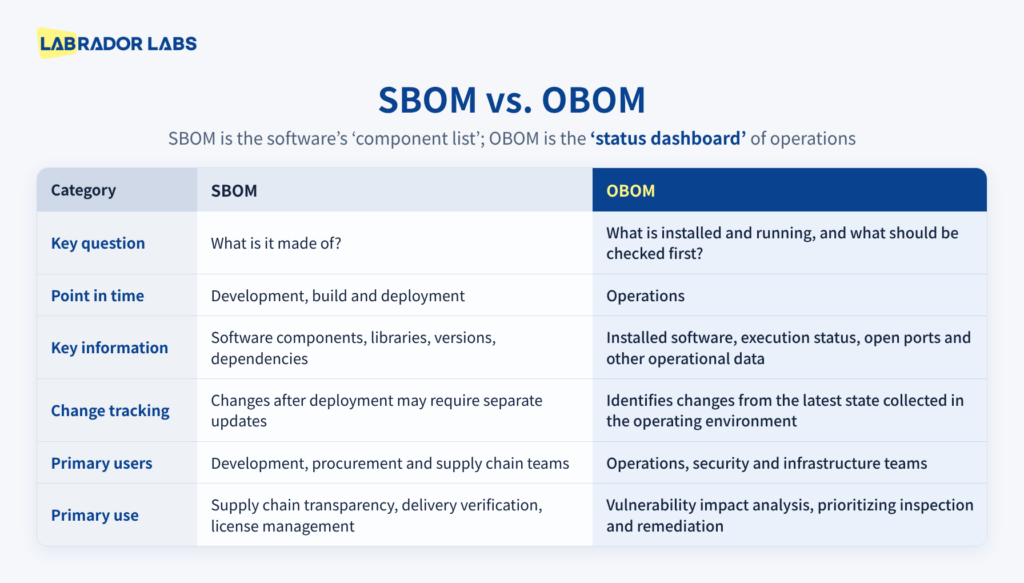
The two don’t replace each other. An SBOM shows where your software came from; an OBOM shows what it looks like in operation right now. If you already manage SBOMs, an OBOM adds the operational context to get more out of them.
Why OBOM, and Why Now?
Operating environments never stand still. Updates and patches get applied, new programs get added, and old ones fall out of use. A list made at development or delivery time can’t tell you how secure your servers are today.
On top of that, AI is speeding up vulnerability discovery, which means more security issues for organizations to review. Attackers have access to the same technology. Instead of trying to fix every vulnerability at once, teams need to quickly find the ones that affect their environment.
To set priorities, you need to know which servers have the vulnerable software, whether it is running, and whether it is exposed externally. An OBOM gives you that information.
See the Current State of Your Operating Servers with ServerCare Plus
Labrador Labs’ ServerCare Plus examines the software makeup, execution status, and open ports of your operating servers to show you what to check first. Results are delivered as an OBOM based on CycloneDX, the international standard, so you can review and manage them with ease.
What’s on your servers, and where should you start?
Request a ServerCare Plus demo or PoC and see your operating servers in a CycloneDX OBOM.
📌 Talk to our Sales Team!
Phone: US Office +1 650-278-9253 (Mon–Fri, 9 AM–6 PM)
Email: contact@labradorlabs.ai (1:1 demo requests and pricing inquiries)