

The idea of creating a Software Bill of Materials (SBOM) and strengthening supply chain security is no longer new.
Today, nearly every organization relies on open source and external libraries, and we’ve all seen how a single vulnerability can spread across multiple products and services at once.
Enterprises, public institutions, and financial organizations all agree: SBOMs must be created and shared.
Yet in practice, supply chain security processes are still often incomplete.
While some companies are ready internally, their partners frequently face delays in participation.
Why does this happen?
Because supply chain security isn’t just about changing “our internal system”
It’s about getting our partners on board too. That’s why companies need to start with a different question.
Not “How do we collect SBOMs?” but rather, “How do we make it easy for our partners to submit them?”
Step 1. Understand Your Partners’ Burden-They’re Not Against Security, They’re Afraid of the Cost
Partners often face very real challenges when it comes to supply chain security. The biggest one is cost.
From adopting SBOM generation tools to allocating personnel, expenses add up quickly.
The process also isn’t a one-time task SBOMs must be regularly updated. For smaller partners, “We don’t even have a dedicated security officer” is a common reality. When new security requirements feel like “another project,” participation naturally decreases.
In short, the key to successful supply chain security is not just technology. it’s reducing the perceived burden for partners.
Step 2. Simplify the Structure-Focus on Licensing and Operation
To extend SBOMs across your organization and partners, you need an environment that’s easy for everyone to participate in.
Partners often ask: “Do we need to buy new tools for this?” “Is the contract complicated?” “Can we use our current methods?”
Every industry’s supply chain is structured differently.
Financial institutions and government agencies may involve many partners and strict audits, while manufacturing and SI sectors operate on project-based chains.
SBOM processes must therefore be designed to fit your industry’s structure and transaction model.
Remember, supply chains are only as strong as their weakest link and that’s often the smallest vendor.
If smaller partners can’t participate easily, your entire security framework is at risk. Sustainable supply chain security starts with systems that even small partners can manage.
Step 3. Build a Sustainable System-Lower Barriers, Ensure Continuity
If partners must make major decisions just to begin participating, progress will stall. Companies should support gradual, flexible adoption that accounts for each partner’s capacity and cost structure.
SBOM management is a continuous process. As software versions change, so must the SBOM. New vulnerabilities and license issues will keep emerging. For long-term success, security tasks must evolve from being “extra work” to becoming a seamless part of daily operations. Reducing partners’overall operational burden is key to sustainability.
Step 4. The Bottom Line Increase Partner Participation
“When partners can participate without burden, the supply chain tightens and security becomes reality.”
Labrador Labs SCM (SBOM Exchange Platform) provides a practical framework for real-world supply chain security by enabling effortless partner participation. Partner-friendly SCA licensing One of the most burdensome aspects for partners is the need to buy new tools.
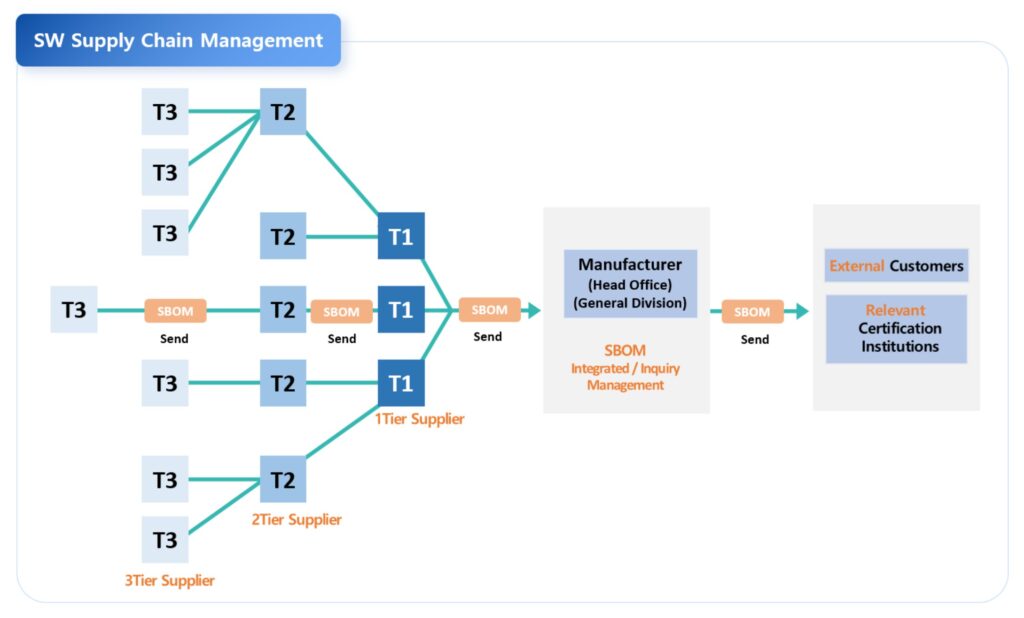
1) Partner-friendly SCA licensing One of the most burdensome aspects for partners is the need to buy new tools.
Labrador Labs SCM solves this directly by offering a license model that allows partners to deploy and use SCA (Software Composition Analysis) tools without additional cost. In practice, the client company can distribute standardized tools across the supply chain, allowing partners to participate easily within that framework.
2) Flexible licensing to match industry needs
Because supply chain structures vary by sector, SCM licensing is not one-size-fits-all. Instead, it adapts to each industry’s characteristics such as transaction models, audit requirements, and partner scale.
3) Affordable cost structure for partners
Even when partners need to implement SBOM tools themselves, Labrador Labs SCM offers a way to integrate into the system at a modest annual cost often just a few million KRW allowing them to immediately start their supply chain security journey.
In the end, supply chain security doesn’t succeed through policies alone, but through structure.
If you want to build an SBOM framework that encourages seamless partner participation, contact Labrador Labs.
Team Labrador Labs can assess your supply chain’s current structure, design a partner participation model tailored to your industry and operation style, and propose a step-by-step roadmap from first-tier to Nth-tier partners that fits each partner’s capabilities and scale.
📌 Get started with Labrador SCM today!
Phone: US Office +1 650-278-9253 (Mon–Fri, 9 AM–6 PM)
Email: contact@labradorlabs.ai (1:1 demo requests and pricing inquiries)